Please enable JavaScript to experience the interactive version of the interactive
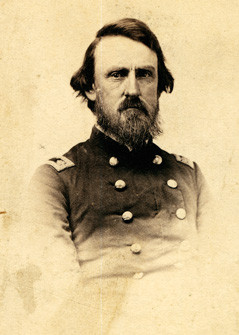
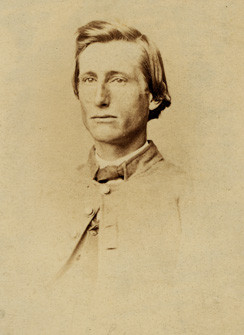
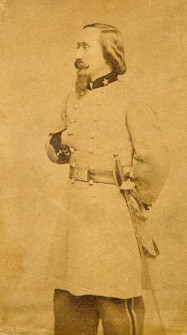
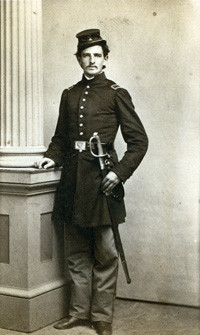
Almost 200,000 Missourian's fought in the Civil War. They served in the Union Army, the Confederate Army, and in Missouri militias. Many of those who fought have been overlooked by history. Learn more about the men and women who served by clicking an image below to learn about that soldier.
See Image in Gallery
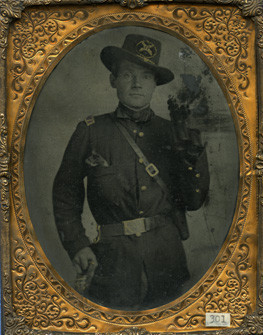
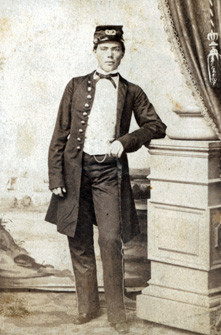
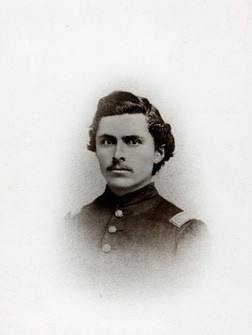
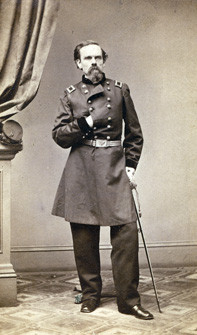
Prior to the war Robert White formed a business partnership with William Blake (White and Blake) in St. Louis. The company, which dealt with plumbing, tinning, and stove dealing, was “measurably successful.” White claims in his memoirs that when he heard the “rumblings of rebellion” from the South he became committed to his country. In 1861, he was instrumental in the formation of the 5th United States Reserve Corps, which was mustered into Federal service at the St. Louis Arsenal following Camp Jackson. White was elected lieutenant colonel of the unit. On the same day of his enlistment, while marching back from the Arsenal to their garrison at Stifel's brewery, they encountered a large and angry mob at 5th and Walnut streets on the porch of the Presbyterian Church. White describes the following event, saying, “I thought our men in the rear were being shot down by the raking fire of the rebels...as to this I cannot testify.” His unit fired upon the crowd, resulting in the death and injury of several in the crowd.
Shortly after this event he loaded a steamer and joined General Lyon's force at Boonville. On June 15 he and Charles Stifel were given orders to guard boats moving supplies from St. Louis to Boonville and Jefferson City. He did so after leaving most of his men under the leadership of Henry Bornstein at Jefferson City. Eventually he served, guarding Lexington, Missouri. When General Sterling Price attacked that city, White was badly injured and left Lexington for St. Louis. This ended his service, but the injuries he sustained stayed with him long after the war, leading to the failure of his business and many other hardships.
See Images in Gallery: White as soldier, White as civilian
Samuel, the grandson of explorer William Clark, was attending West Point at the beginning of the war. His deep Southern sympathies caused him to leave on July 1, 1861. He returned to his family home in St. Louis briefly before heading to Richmond to apply for a Confederate commission, eventually making his way to Lexington, MO, on September 13, 1861, with a dispatch from General Leonidas Polk for General Sterling Price. At Lexington, Samuel would join the Missouri State Guard as a colonel. Samuel “supervised three six pound artillery pieces and their cannoneers” during the siege of Lexington on September 18.
In October, Samuel received an appointment as captain of the 1st Battery of Artillery, 4th Division, Missouri State Guard, but by the end of the year he had joined the Confederate army. His father, Meriwether, signed off on his son’s appointment as cadet in the Corps of Artillery.
In November, Samuel sent his final letter to his father before his death at the Battle of Pea Ridge after being decapitated by a cannonball. The letter closes saying, “I am very comfortably situated and ready to give the “Feds” 200 rounds at a moment’s notice. Good bye and may god bless and preserve you always will be the prayer of your most devoted son.”
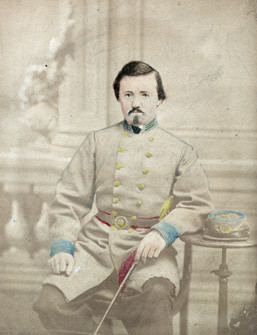
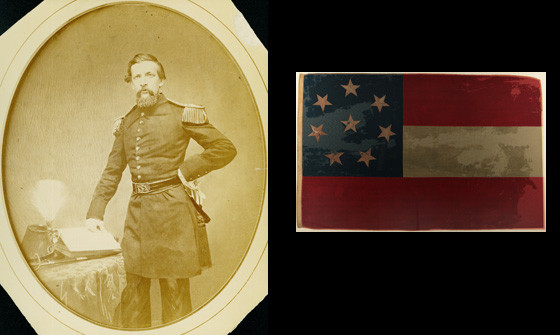
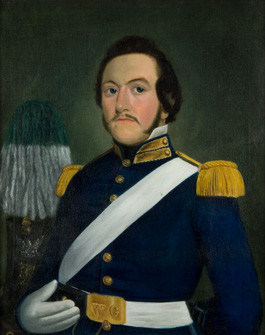
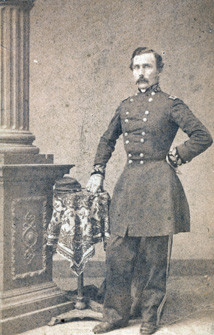
John S. Bowen, a native of Liberty County, Georgia, was admitted to the U.S. Military Academy on July 1, 1848, and graduated 13th in his class in 1853. Bowen was stationed at Jefferson Barracks in 1853 and married Mary Kennerly on May 8, 1854. Bowen served along the Missouri-Kansas border and was left in charge of what became known as the “Southwest Expedition,” a smaller force that was left to protect the Missouri border from Kansas Free Soiler raiders.
Prior to the Civil War, Bowen was elected as colonel of the 2nd Regiment Missouri Volunteer Militia, which was captured at Camp Jackson on May 10, 1861. Immediately after his parole, he left for Richmond, Virginia, where he received a commission as colonel in the Confederate army on May 19, 1861. Bowen went to Memphis, Tennessee, where he organized the 1st Missouri Infantry Regiment, the first Missouri Regiment organized for the Confederacy. Bowen was promoted to brigadier general in March of 1862 and led a brigade at the Battle of Shiloh, where he was wounded in the right shoulder during a charge. He served at Corinth and Vicksburg, reaching the rank of maj. general. After the fall of Vicksburg, Bowen and his wife and children left Vicksburg in an army ambulance and made it to Raymond, Mississippi, before he began to weaken. Bowen died of dysentery on July 13, 1863, probably due to the deplorable conditions the Confederate forces faced in Vicksburg.
See Images in Gallery: Bowen portrait, Missouri flag
John Q. Burbridge was a 31-year-old resident of Louisiana, Missouri, when the Civil War began. He joined the war effort in June 1861 by recruiting a small band of men and joining the Missouri State Guard. At Cowskin Prairie, Burbridge was elected captain of the Jackson Guards and within days appointed colonel of the 1st Infantry, 3ird Division, Missouri State Guard. With this regiment, Burbridge fought at the battle of Carthage, Missouri, and at the Battle of Wilson’s Creek. After recovering from a head wound he received at Wilson’s Creek, he was given the command of the 2nd Calvary Regiment, 2nd Division, Missouri State Guard.
Col. Burbridge continued his zealous service on January 16, 1862, by helping to organize the 1st Missouri Infantry Regiment (Confederate) and serving as the unit’s colonel. He fought with this unit in the Battle of Pea Ridge. During the summer of 1862, Burbridge organized the 4th Missouri Cavalry and proved himself an able-bodied commander. Burbridge was recommended to be promoted to brigadier general by the Missouri congressional delegation in 1864. He never received his promotion, however, because the War Department felt that Missouri already had its share of generals. Burbridge completed his Civil War service by participating in Price’s 1864 raid, where he commanded a brigade.
In Missouri, feelings ran strongly in the hearts of many residents over the future of the nation. William H. Lusk, a veteran of the Mexican-American War whose family came from Pennsylvania, was the owner of the Jefferson Inquirer. In his newspaper, he struck out boldly and fearlessly for the Union, but in March 1861, the paper went under. After the loss of his paper, William became the confidential correspondent of Frank P. Blair and then Captain Nathaniel Lyon, in command of the U.S. Arsenal at St. Louis. Facts obtained through his correspondence would contribute to the removal of General Harney and to the capture of Camp Jackson.
After the Camp Jackson affair, Lusk served for three months as captain of Company B, Colonel Richardson’s Regiment, U.S. Reserve Corps. He was then appointed assistant provost marshal and served until he was commissioned as recruiting officer with the rank of lieutenant and raised four companies of U.S. Volunteers. On September 1, 1862, he was promoted to CAPTAIN and assigned to Company E, which later formed a part of the 10th Missouri Cavalry. On December 4, 1862, he was promoted to major of the regiment and held the position until the close of the war. Major Lusk was chairman of the Cole County Democratic Committee and ran unsuccessfully for the legislature in 1866. In 1870 he was elected clerk of the circuit court and ex-officio recorder. On February 1, 1871, in Pittsburgh, PA, he married Christine Hager.
For many soldiers, both Union and Confederate, brawls between fellow soldiers were common. Mr. Elijah Magoffin, a wealthy farmer who resided near Hughesville, Missouri, served as a Confederate soldier until close to the end of the war. His life, however, was cut short when he attempted to break up a barroom fight between a friend and another man. Magoffin died instantly when a large bowie knife pierced his heart. His son later chased down the culprit in Texas and hung him.
Early in the war in August 1861, Magoffin had been arrested for killing two Union soldiers that he feared were coming to arrest him for his Confederate activities. While imprisoned in the Alton military prison, he, two of his sons, and another prisoner escaped to rejoin the Confederates.
Some Americans living and working overseas felt that it was their duty to return to their homeland when the Civil War began. Charles Michel, a physician specializing in ophthalmology, was born and educated in Charleston, South Carolina, but was working in Paris, France, until 1860, when U.S. politics were becoming heated. Back at home, he served the Confederate army as surgeon in the field, and later was in charge of hospitals at Graysville, Marietta, Atlanta, and Macon, Georgia.
After the war Dr. Michel settled in St. Louis and set up his own practice specializing in ophthalmology. He also served as a professor of ophthalmology at the Missouri Medical College from 1869 to 1907. He was an ex-member of the St. Louis Medical Society and Missouri State Medical Association. Dr. Michel died peaceably in his home at the age of 80 in 1913, one year after he retired.
Accidents and diseases were far greater threats to soldiers’ lives than battle. Lieutenant Alexander Pfeiffer died on August 10, 1862, when he lost his footing and drowned while bathing with other soldiers in the Mississippi River near Helena, Missouri. The search for his body was unsuccessful and was called off on the day following his death.
Pfeiffer was a well-liked officer, and his death hit his fellow soldiers hard. His loss so touched the regimental officers that they adopted a set of resolutions offering condolences to Pfeiffer’s parents and wore badges of mourning for seven days in his memory.
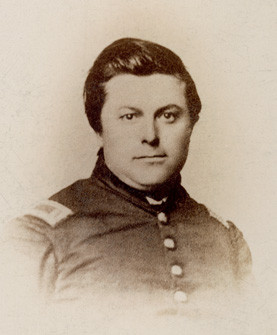
At the time of the Civil War, the voting age was still 21 years old. This did not, however, prevent young men under this age from being dragged into war. In May of 1861 Leo Rassieur was one of those men. He enlisted as a private in Company B, 1st USRC (three months). He was quickly promoted to orderly sergeant. After his three-month commission ended he re-enlisted as a private in Company E, 1st USRC (three years) and was at once elected 1st lieutenant of his company. By April 21, 1862, however, he became too sick to remain and was mustered out of the service. When his health returned in August, he enlisted again as a recruiting 2nd lieutenant for the 34th Missouri Infantry, which became the 30th Missouri Infantry. Upon the company’s organization, he was commissioned its captain.
Rassieur also served as judge-advocate of General Dennis's division of the 19th Corps, Army of the Gulf, in 1864. In September 1864 he was commissioned major of his regiment, but was never mustered as such because of the depletion of the regiment to less than 500 effective men. He was honorably mustered out of the service on August 21, 1865, at Alleyton, Texas, and returned to St. Louis the following month.
After his return he studied law, was admitted to the bar, and was in active practice until he was elected judge of probate in St. Louis in 1894. For ten years he was the attorney for the St. Louis School Board and for four years was a member of that body, serving as its vice president. Interested in athletics, he served as president of the St. Louis Gymnastic Society and for 13 years was president of the Western Rowing Club, the largest organization of its kind in the West. Rassieur died June 1, 1929, in St. Louis, MO.
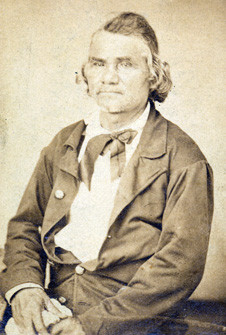
Native American politics also played an important role in the Civil War. The Cherokee chose to side with the Confederacy, and Stand Watie became the only Native American general of the Civil War. Before the war, Watie and a handful of his allies betrayed Cherokee law by signing away their ancestral homeland and agreeing to relocate to Indian Territory in the West. Watie’s action forced a divide in the Cherokee Nation as well as forced the exodus of the Cherokee to Oklahoma.
General Watie and his Native American troops operated primarily in Indian Territory and Arkansas. They did, however, ally with General Sterling Price of Missouri. In the Battle of Wilson’s Creek they helped earn the Confederate victory that left the southern half of Missouri contested in the start of the war. They also fought fiercely at Pea Ridge and Shiloh. General Watie would be the last Confederate general to surrender, on June 23, 1865, two months after the Battle of Appomattox. After the Civil War Watie remained in exile in the Choctaw Nation until 1867. He then returned to Honey Creek, Oklahoma, to rebuild his home. He died there on September 9, 1871. He was buried in the Old Ridge Cemetery, later called Polson's Cemetery, in Delaware County, OK.
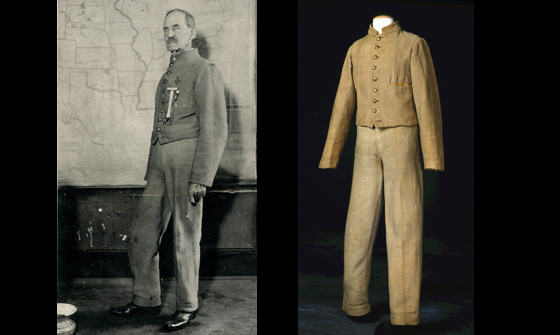
John Appler was born in Uniontown, Maryland, on November 16, 1842. He later moved to Missouri and answered Governor Jackson’s call for troops during the secession crisis early in 1861 at Hannibal, Missouri. Appler later joined Company K, 4th Missouri Infantry Regiment of the Confederate army on April 27, 1862, in Memphis, Tennessee. While in the Confederate army, Appler fought in the battles of Corinth and Farmington, MS; Jackson, TN; Iuka, MS; and at later at Grand Gulf and Port Gibson, MS; Hard Times Landing, LA; and Champion Hill, MS; during the Vicksburg campaign. During his exploits, Appler was wounded twice, first at the Battle of Corinth in October of 1862, where he was shot in the shoulder, and then at the Battle of Champion Hill on May 16, 1863. He described how after his second wound he was “left for dead” overnight on the battlefield when his unit retreated, and he told of his second capture the next morning by Federal troops.
Toward the end of the war Appler moved to St. Louis. He worked as a printer for the St. Louis Republican newspaper and became active in Confederate veterans’ activities, eventually becoming commander of the United Confederate Veterans Camp 731 in St. Louis.
See Images in Gallery: Appler wearing uniform, uniform itself
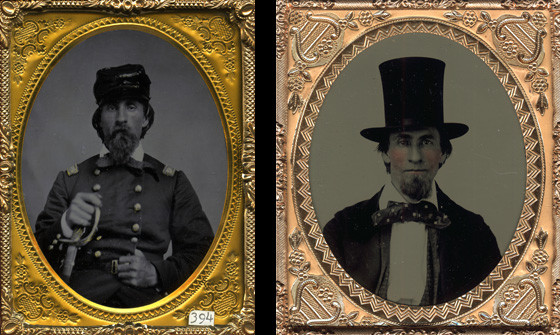
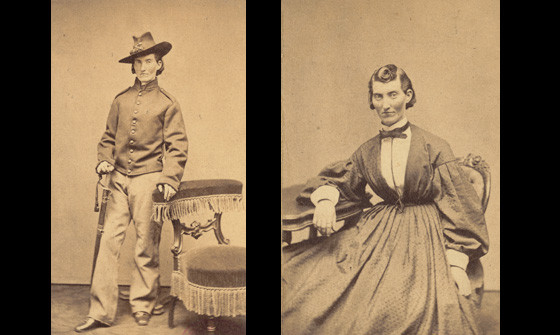
See Images in Gallery: Clayton as soldier, Clayton as civilian